The biomarker prevalence data your strategy actually needs
NeoGenomics Real-World Insights turns source data into prevalence, testing trends, and concordance insights that drive clinical strategy, publication planning, and payer evidence. NeoGenomics data is grounded in what’s actually happening in community oncology settings, not what’s inferred from claims.
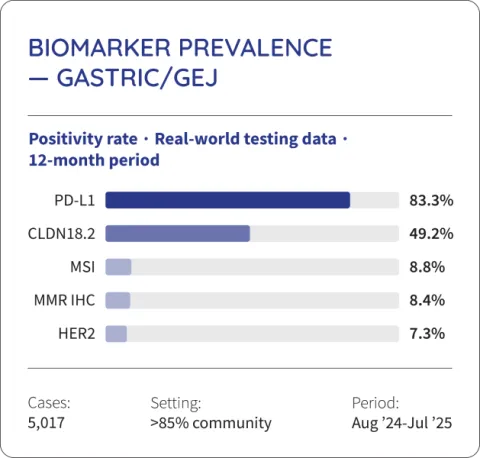
ODS RWI stats
What's in the dataset
NeoGenomics Real-World Insights draws from our multimodal clinicogenomic database of structured, de-identified, first-party lab data across five testing modalities.
NGS panel results, mutation status, gene fusions, copy number variants —all from the lab that generated them.
IHC results across 335 IHC markers including PD-L1, HER2, CLDN18.2, FOLR1, and emerging biomarkers, with clone, score, expression levels, and indication with source digital pathology images.
Ordering volume over time, single-gene vs. NGS adoption rates, guideline-to-practice gaps by setting and region.
Real-World Insights serves teams across Medical Affairs, Research, and Commercialization with deliverable types ranging from publication-ready analyses to strategic briefings.
CommercializationPre-launch market sizing
Understand the biomarker-eligible population in your target indication before launch, by territory, practice setting, and HCP, with data that reflects community oncology, not trial populations.
- Biomarker positivity rates by tumor type and geography
- HCP-level testing volume and practice-setting segmentation
- Concordance between test results and therapy adoption
Medical AffairsPublication strategy
Real-world biomarker prevalence and testing pattern data is the foundation of high-impact publications. Our data has supported manuscripts across ASCO, ASH, and peer-reviewed journals.
- Cohort-level prevalence data with clear methodology for peer review
- Trend analysis showing guideline adoption over time
- Rare subtype identification across 3M+ patient profiles
Research | HEORPayer dossier and burden-of-disease studies
Lab-confirmed molecular data, not claims proxies, gives payer submissions a defensible foundation for population sizing, testing rate analysis, and economic burden modeling.
- Prevalence rates from actual diagnostic results, not inferred codes
- Testing gap data linking diagnosis to downstream biomarker testing
- CDx strategy support with real-world positivity benchmarks
KOL and Guideline StrategyIdentify where practice lags guidelines
Our data shows what's actually ordered in the community vs. what NCCN recommends — the gap is where Medical Affairs education programs create the most impact.
- Single-gene vs. comprehensive NGS adoption by setting
- Time-from-diagnosis-to-test data across tumor types
- Identifies high-impact HCP and account targets for education