Follow the patient from the first test to treatment and beyond
NeoGenomics Patient Journey connects longitudinal clinicogenomic data across the full patient timeline. From initial diagnosis to biomarker testing, through therapy selection, response, and disease progression, understand what actually happens to patients after a result, not just what the result was.
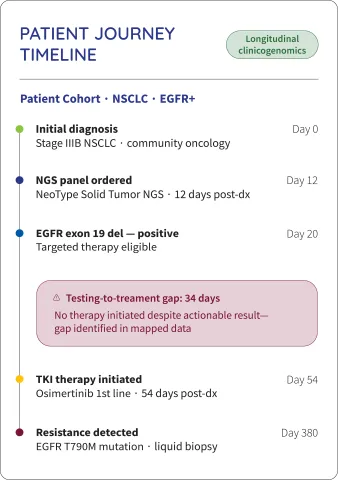
ODS patient journey
Patient Journey is uniquely suited to questions that can't be answered by a single test result when the sequence of events, timing, and treatment context matter as much as the biomarker itself.
CommercializationMeasure the result-to-treatment gap
Quantify how long it takes from a positive biomarker result to therapy initiation by HCP, account, and territory, and identify where that gap is widest.
- Baseline and post-intervention gap measurement
- Territory-level concordance between result and drug selection
- Identify accounts where positive results aren't converting to treatment
Medical AffairsLongitudinal RWE for publication
Linked clinicogenomic data supports time-to-event analyses, treatment sequencing studies, and resistance-mechanism exploration, the kind of RWE Medical Affairs teams need for high-impact publications.
- Time-to-treatment and time-to-next-test analyses
- Treatment sequencing patterns in the community setting
- Biomarker co-occurrence and clonal evolution data
Research | HEORDisease burden and economic modeling
Understand the full clinical and economic burden of a tumor type across the patient journey, from initial workup costs through treatment lines, supported by linked claims data.
- Multi-line therapy cost modeling with real treatment sequences
- Biomarker-stratified outcomes for payer submissions
- Testing pathway analysis for CDx strategy and cost-effectiveness
Clinical Trial OptimizationFeasibility and site identification
Match your trial's inclusion/exclusion criteria against real patient profiles to identify eligible patients and high-volume investigator sites before you recruit.
- I/E criteria matching across 3.6M+ patient records
- Site-level patient flow to prioritize investigator selection
- Historical treatment sequences to inform comparator arm design
Why first-party journey data is different
Most patient journey datasets are built from claims codes. NeoGenomics Patient Journey starts with the actual lab result.
| Lab-confirmed biomarker status Every biomarker data point comes from an actual test result — not a diagnosis code used as a proxy. | vs. claims: inferred from billing codes |
| Exact test timing We know the precise date a test was ordered, resulted, and linked to a treating provider — not approximated from claim dates. | vs. claims: date-of-service lag |
| Community-representative population 85%+ of our testing comes from community oncology (not academic centers) reflecting where patients are actually treated. | vs. registry data: academic-center bias |