RaDaR® ST—Immunotherapy response monitoring
When imaging alone doesn’t tell the whole story
Assessing response to immunotherapy can be challenging. Pseudoprogression, delayed response, and mixed response may make conventional imaging difficult to interpret and complicate clinical decision-making. However, patients may derive meaningful clinical benefit from immunotherapy despite delayed, mixed, or perceived radiographic progression.1
RaDaR ST provides a personalized molecular view of ctDNA dynamics over time, helping characterize immunotherapy response alongside imaging and clinical evaluation.1,2,3
Order RaDaR ST for Immunotherapy response monitoringDownload the Immunotherapy brochure
From imaging uncertainty to molecular insight

Changes in ctDNA may provide insight into treatment response before those changes are visible through imaging.1,2,3

Early ctDNA decrease or clearance has been associated with improved disease-free survival, progression-free survival, and overall survival compared with no molecular response1,2,3

Serial ctDNA monitoring provides an additional molecular view of treatment response and disease dynamics over time. Interpret results alongside imaging, clinical evaluation, and other relevant patient information.1,2,3
What longitudinal ctDNA monitoring may reveal
Across multiple studies, ctDNA clearance and decreasing ctDNA identified patients benefiting from immunotherapy, while persistent or increasing ctDNA provided an early indication of limited molecular response.1,2,3
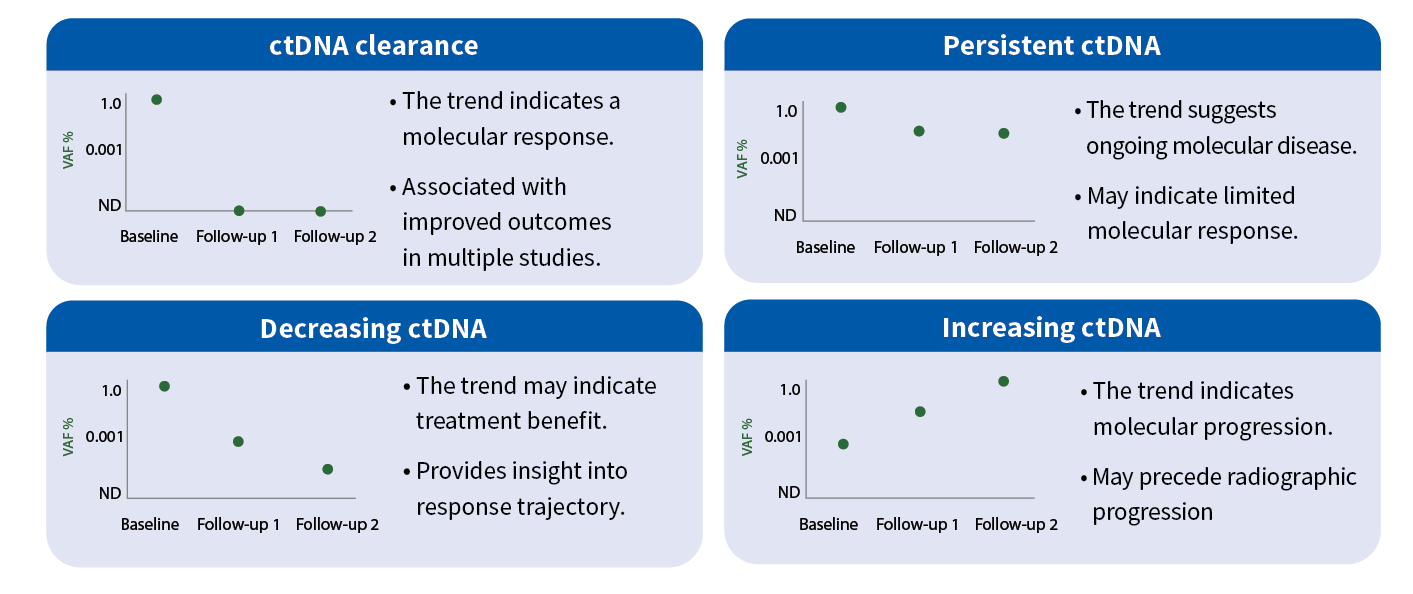
Molecular response assessment with RaDaR ST across immunotherapy settings
Serial molecular monitoring with RaDaR ST may help distinguish patients experiencing treatment benefit from those with persistent or progressive molecular disease. RaDaR ST has demonstrated clinical performance in immunotherapy response monitoring across the continuum of cancer care.1,2,3

Neoadjuvant immunotherapy
In the NABUCCO study of patients with stage III muscle-invasive bladder cancer receiving neoadjuvant immunotherapy:
Patients who achieved ctDNA clearance after neoadjuvant immunotherapy and before surgery demonstrated approximately 45-fold greater odds of achieving a pathologic complete response.
ctDNA clearance was strongly associated with improved progression-free survival and overall survival.1
Adjuvant immunotherapy
In the OXEL study of patients with residual TNBC following neoadjuvant therapy and treated with adjuvant nivolumab and/or capecitabine, ctDNA identified patients at greatest risk and led to worse clinical outcomes.
Postoperative ctDNA positivity identified patients at greatest risk of recurrence.
Patients who were ctDNA-positive at landmark assessment had inferior median invasive disease-free survival compared with patients who were ctDNA-negative.
All ctDNA-positive patients who failed to clear ctDNA by week 6 experienced recurrence. 2
Advanced or metastatic disease
In the Ruiz-Torres et al. study, patients with recurrent or metastatic head and neck squamous cell carcinoma receiving immunotherapy, ctDNA dynamics were strongly associated with disease control and clinical outcomes:
Patients who achieved ctDNA clearance during treatment had approximately 22-fold greater odds of disease control.
ctDNA clearance during immunotherapy treatment was associated with a 97% lower risk of disease progression (HR 0.03, P=0.006) and a 96% lower risk of death (HR 0.04, P=0.003).³
RaDaR ST is not intended to replace imaging or clinical evaluation. It provides an additional, personalized molecular view that may help clinicians:
Characterize treatment response over time
Identify molecular response or progression earlier
Add context when imaging findings are uncertain
Better understand disease dynamics during immunotherapy
RaDaR ST results should be interpreted together with imaging, clinical evaluation, treatment history, and other relevant clinical information.
van Dorp J, Pipinikas C, Suelmann BBM, et al. High- or low-dose preoperative ipilimumab plus nivolumab in stage III urothelial cancer: the phase 1B NABUCCO trial. Nat Med. 2023;29(3):588-592. doi:10.1038/s41591-022-02199-y
Lynce F, Mainor C, Donahue RN, et al. Adjuvant nivolumab, capecitabine or the combination in patients with residual triple-negative breast cancer: the OXEL randomized phase II study. Nat Commun. 2024;15(1):2691. Published 2024 Mar 27. doi:10.1038/s41467-024-46961-x
Ruiz-Torres DA, Merkin RD, Bryan M, et al. Personalized circulating tumor DNA dynamics predict survival and response to immune checkpoint blockade in recurrent/metastatic head and neck cancer. Preprint. medRxiv. 2025;2025.01.27.25321198. Published 2025 Jan 28. doi:10.1101/2025.01.27.25321198